

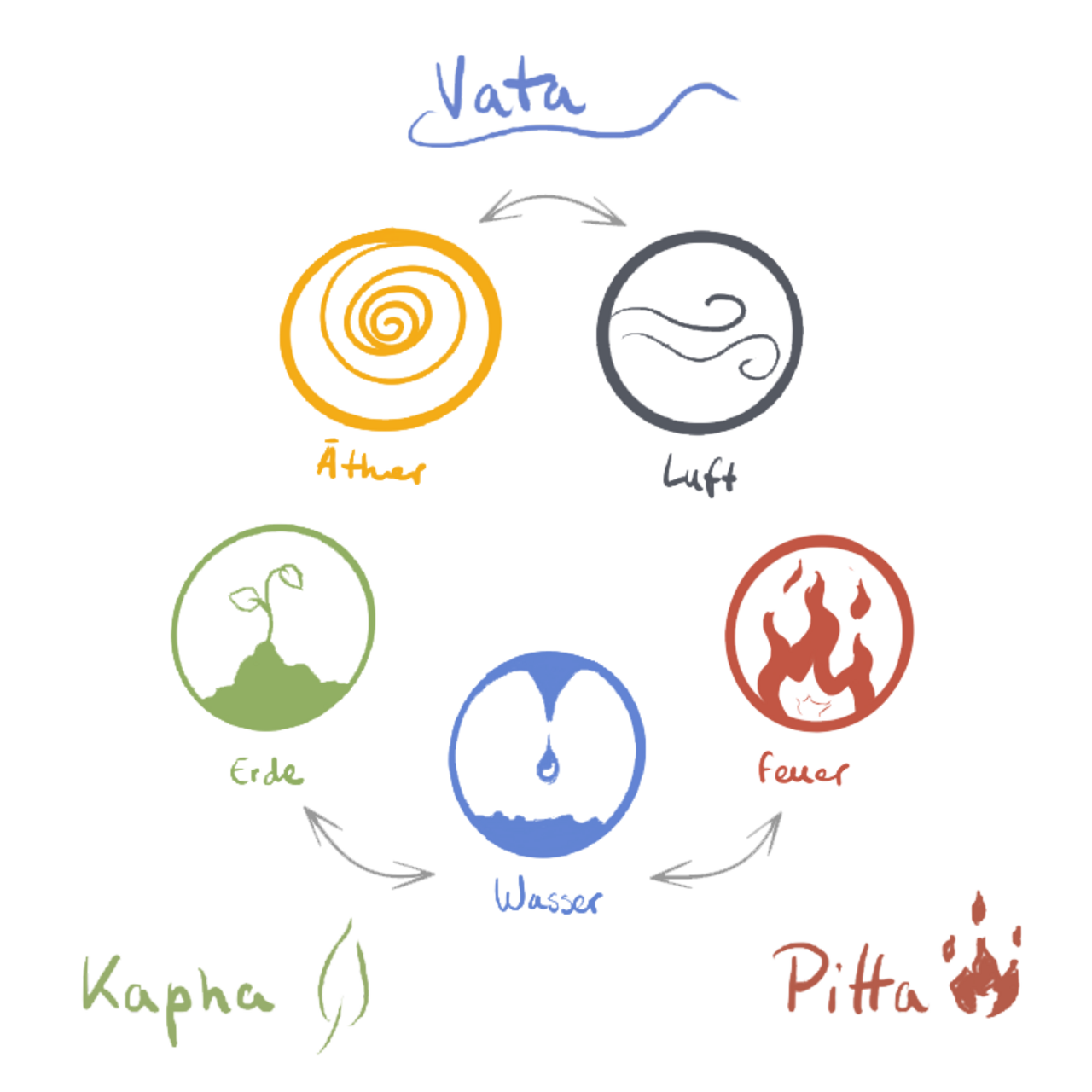
Determining the constitution is one of the most important core aspects of Ayurvedic healing and life science. Every person is unique and has an incomparable profile on the physical and psychological level. The individual constitution (Prakriti) is described on the physical and psychological level by the quality and manifestation of the three doshas. These are called Vata, Pitta and Kapha and represent biological forces that control our organism on a structural and functional level. Thus, from an Ayurvedic perspective, our constitution is formed from a unique mixture of Vata, Pitta and Kapha.
in Ayurveda, "being healthy" means being in inner balance with your own constitution. Illnesses are caused by an imbalance of physical and mental forces. Health feels a little different for each person. Depending on our constitution, we prefer different lifestyles, climatic conditions or mental challenges.
Vata
People with a Vata constitution are by nature very delicate and sensitive personality types, characterized by a slender build, dry skin and artistic and sensitive abilities.
Curiosity and need for movement
As Vata is the most mobile principle, its predominance offers speed, instability and a multi-faceted personality with many different interests and talents. Vata people are always physically and mentally active, curious and have a strong need to move.
Escape from the northern European winter
Their digestion is a very sensitive bodily function. Vata types naturally have an irregular appetite and react immediately to stress, the wrong food and inner tension with flatulence and constipation. Their nervous system is sensitive and their physical strength and resistance to illness is rather low. Vata people are particularly sensitive to cold and wind. In the cold season, they long for light and warmth. As a result, they generally flee the dreary northern European fall and winter whenever possible.
Great strength: communication
A great strength of Vata lies in communication. Vata types have an open nature, are good at establishing contact and are usually talkative. Their wealth of ideas and creativity are remarkable and they start new activities with great enthusiasm. They take great pleasure in learning new things and enriching their lives with changes. Unfortunately, they lack stamina and often pursue several projects at the same time without fully concentrating on one. This quickly leads to overload, but protects them from boredom and routine.
Tendency to illness
Vata people are generally prone to mental and psychosomatic illnesses. Their musculoskeletal system is sensitive to disturbances and they are prone to digestive problems, exhaustion, anxiety, sleep disorders, ringing in the ears, tinnitus, heart disease and neuralgic pain, which occur more frequently with physical or mental overload, stress and in old age.
Pitta
Pitta people are very dynamic, successful and impressive personalities. They have an extraordinary energy potential and are physically and mentally very powerful. The fiery Pitta gives heat, spiciness and acidity. This results in good digestion, a good metabolic rate, profuse sweating and warm skin with good circulation.
Good reasoning ability
Pitta people love sporting activities and find a relaxing balance to their often tense minds through physical exercise. Pitta gives the voice sharpness and fluent, clear speech. These people have good reasoning skills, which they can use to convince others. They are good speakers and usually have a special place in meetings, discussions and seminars. They love debating and discussing. They are often dominant, assertive and have a pronounced ability to act.
Physical complaints
On a physical level, they tend to suffer from skin complaints, hyperacidity, inflammation and problems with the liver and other digestive organs.
Kapha
Kapha people are characterized by their inner strength and stability. They are strongly built, have a good immune system and are extremely calm in their dealings with other people and themselves.
Tolerant, contented personality
Kapha is a watery and earthy principle that offers structural compactness, stability, slowness, security, contentment and a tolerant personality. The body of a Kapha person is well developed with rounded contours. Kapha people, although they eat little, show a tendency to put on weight. They have beautiful, smooth skin, large expressive eyes and strong hair. Their physical strength is remarkable and they have good resistance to disease. However, they can suffer from diabetes or lung, bronchial and sinus problems. Obesity and diseases related to excess fat are also common complaints when Kapha dosha is dominant.
Calm, balanced and loyal
Of all constitutional types, they have the least tendency to mental disorders. They have a calm, balanced nature and are highly loyal, reliable and faithful. However, they have a strong tendency towards complacency and inner phlegm. Their physical and mental drive is low and they often need a lot of time for themselves and the tasks to be performed.
Vata-Pitta
People with a Vata-Pitta constitution are made for the modern lifestyle of our time. They are attractive, fun-loving and lively, have an alert mind and are very good communicators. Ideally, the positive characteristics of Vata with its joy of movement, creativity and quick perception are combined with the determination, intelligence and leadership qualities of Pitta. The body is slim and powerful, the hair is fine and soft and the whole personality radiates vitality and positive dynamism.
Disharmony of both body energies
Unfortunately, in most cases not only the positive characteristics of the doshas mix. Many people with a Vata-Pitta constitution suffer from the disharmony of both body energies in the event of a disorder, which often manifests itself in nervousness and restlessness (Vata), inner tension and irritability (Pitta), sleep disorders, headaches, skin impurities and a sensitive stomach.
The focus is on movement
On a physical level, a Vata-Pitta constitution focuses on movement, as both Vata and Pitta are very dynamic doshas. Vata-Pitta people are generally very athletic and have a good metabolism. Their physique is delicate yet full of energy. The skin is often sensitive and reacts sensitively to chemical substances. The enjoyment of sweet foods is usually highly valued even in childhood, and there is also a preference for music, painting and other fine arts. The desire for a healthy and spiritually oriented lifestyle can also be very pronounced.
Vata-Kapha
People with a Vata-Kapha constitution are extremely interesting personalities who constantly reveal new surprises. The pronounced dominance of the opposing elements air, earth and water is reflected in complex characteristics on a physical and psychological level. On the one hand, the Vata element gives lightness, creativity and volatility. This can be seen, for example, in a slender physique, quick speech and inner restlessness.
Versatile interests and abilities
The Kapha part, on the other hand, is characterized by heaviness, stability and moisture. For example, the skin may be very thick, prone to water retention and cellulite, or the person may be strongly concerned with security and traditions. The variations in how Vata and Kapha express themselves are unlimited and give rise to a wide range of interests and abilities.
Sociable, curious and social
People with a Vata-Kapha constitution are very sociable, popular and communicative. The Vata part is open, curious and loves conversation, while Kapha is very caring, social and welcoming. The ideal mix for an exciting conversation and good friendship.
Pitta-Kapha
If there is a power constitution, then it is the Pitta-Kapha constitution. The body is robust and strongly built, the immune system is stable and the stamina and perseverance in all activities is outstanding. With an almost inexhaustible energy, these people pursue their goals unwaveringly and allow (almost) nothing to stop them. The body enjoys very good health and stamina. Strains caused by too much work, eating the wrong food and stress only become noticeable after a few years of overwork. And the mind is also characterized by clarity and calm, perspicacity and patience, determination and composure.
Personalities from business and politics
Many charismatic personalities from the world of politics and business have a Pitta-Kapha constitution, which helps them to survive the strenuous life of a manager with lots of traveling, irregular meals and exhausting competition.
Vata-Pitta-Kapha
If you have a so-called Sama Dosha constitution, which is made up of almost equal proportions of all the elements, you are one of the chosen few who were born with a great natural balance in body and mind.
Most people develop disorders from an imbalance of the three doshas in the course of their lives, such as the sleep disorders of vata, the irritability of pitta and the water retention of kapha. However, only a few people have all doshas evenly distributed in a positive way from the ground up, which leads to a very stable and favored personality structure.
Body, mind and soul are truly in balance
A balanced Tridosha constitution is noticeable in that there are no extreme constitutional characteristics. Body, mind and soul are truly in balance and all characteristics and modes of functioning are present to a sufficient degree. Most Vata-Pitta-Kapha types have a medium build, normal uncomplicated skin and a good metabolism. On a psychological level, they have the creativity and quick perception of Vata, the charismatic charisma and determination of Pitta and the gentleness and calmness of Kapha.
Vata imbalance
Excessive Vata is caused by excessive physical and mental stress as well as an unbalanced lifestyle and loss of energy.
If our life is too fast, if we just rush back and forth and are so annoyed that we can't really get any work done, then our Vata has increased in an unhealthy way.
If Vata is out of balance, this is directly noticeable through inner nervousness, bloating, a dry mouth, a craving for warmth and indefinable fears.
Excessive Vata energy conveys a feeling of emptiness, self-doubt and senselessness; everything in our head whirls around uncoordinatedly and we feel little strength and certainty in our actions.
If this condition persists, bloating and constipation, cold hands and feet and dryness throughout the body and on the skin increasingly develop. The mind becomes increasingly restless and "real" complaints such as insomnia, ringing in the ears and dizziness slowly develop.
A long-lasting dosha increase leads to typical Vata symptoms such as anemia, muscle and bone atrophy, paralysis, memory loss, joint problems, degenerative arthritis and all nervous disorders.
Pitta imbalance
Too much Pitta is caused by too much heat (fire) in the body, which is promoted by a lot of responsibility, pressure to succeed, competition or the excessive consumption of acidic foods (such as citrus fruits, dairy products, meat or alcohol).
We recognize our Pitta disorders immediately through heat, stomach acidity, inner tension and impatience. Inner anger and an addiction to criticism also spread through the mind. This makes it difficult to relax and also prevents us from developing sufficient self-esteem.
If the Pitta elevation becomes entrenched, it manifests itself in heartburn, stomach upset, burning pain in the navel area and an extremely irritable and hypercritical attitude. The skin now begins to react and redness, rashes, headaches and sweating may occur.
Diseases such as fever, inflammation, migraines, accumulations of pus, inflammatory arthritis, bone abscesses and all inflammatory and burning complaints of the liver and gastrointestinal tract develop further down the line.
Kapha imbalance
A Kapha disorder is usually caused by a lack of exercise and joie de vivre and an excess of sweet and fatty foods.
If there is an increase in Kapha, the first symptoms are a lack of drive and a feeling of heaviness. Everything feels heavy and sluggish. Nausea, bloated intestines, water retention and constant tiredness can also occur. The lymphatic system works poorly, water accumulates in the body and metabolic waste products are deposited in the tissues.
If Kapha continues to accumulate, the body begins to produce a lot of mucus, which settles in the sinuses, bronchi and respiratory tract. We suffer from sluggish digestion and develop diseases such as obesity, high cholesterol, weeping eczema, cysts, diabetes and tumor formation.