

Yoga for shoulders and neck
Yoga for shoulders and neck
This article appeared in the March 2017 issue of vita
Searching for causes:
Like many of us, I sit in front of my laptop and concentrate while I think about the best way to start. It's not uncommon for my shoulders to stiffen almost automatically, my neck to bend forward at a strange angle and for me to maintain this posture for several hours. If you now spontaneously feel your shoulders and shoulder blades, what do you feel? Tension? Tension or even a headache? These days, all of this is almost normal. We have become accustomed to pain and cannot afford to take sick leave. The pressure in the performance-oriented world of work is great. Stress and worries also have an effect here. So we prefer not to feel it at all. Or to put it another way: our attention only goes there when the pain is so great that nothing works, i.e. you can no longer turn your head to the side or your shoulder girdle is chronically painful. Persistent headaches are just one of the many symptoms. I have noticed that some of my clients lie on the massage table and almost automatically pull their shoulders towards their ears when I apply the oil. They tense their muscles and don't let go. This reflex is often referred to as a protective reflex to protect the head. And please, dear readers, don't think that I'm a scary, brutal masseuse. No, far from it! I run an Ayurveda studio and have been working in the field of body therapy with great attention and expertise for years. But it is often such a paradox: we want to relax, treat ourselves to a great massage, but our body has trained itself to use mechanisms that are not good for us and are more of a hindrance.
And what does Ayurveda say?
The basic constitution and daily condition of the client is of course of great importance, although we can find shoulder/neck issues in all "Dosha types", for example, we observe that strong Pitta personalities, who like to achieve high perfectionist goals and often go beyond their own limits, simply find it difficult to let go. Vata personalities tend to be psychologically anxious and worry a lot about their job and family. Here, too, there is a permanent tense posture with hunched shoulders. The Kapha constitution tends to be overweight and has a tendency to carry heavier loads, which causes wear and tear to progress more quickly. In practice, we try to determine where the tension may be coming from and then decide on the type-appropriate oil applications. For example, there are wonderful partial back massages with tension-relieving oils or herbal oil applications. We use comfrey pastes or other herbal decoctions. Special bolis, i.e. herbal pouches, can also be used. These are individually tailored to the client. But Kati Basti, the local "oil bath", is also an effective application in which the oil can act on the spine in deeper structures for a certain period of time. A dough made from chickpea flour is kneaded and a small amount is applied to the preferred area. With a subsequent back massage, it helps to create a completely new feeling of well-being in the back. The full body massages in Ayurveda also help to bring the so-called Nadi Marma system into harmony. There are 107 marma points described, which are regarded as vital points. The nadis (subtle energy pathways that run through the body and supply it with prana (= life energy)), as we call the channels, with their 72,000 pathways are regarded as energy suppliers similar to the principle of the meridians.
Abhyanga, the Ayurvedic oil massage
"It envelops, it strokes, it softens and works its way to the bone with its special herbal oils." With this oil massage, we can use the gentle but compact touches to help us relax, soften the tissue and do something good for our soul According to the ancient Vedic scriptures, it is part of the daily routine and promises a long life. We don't always have to go to a practice for this; self-massage is an essential part of physical and mental health in Ayurveda. Performed with a warm herbal oil, it is a blessing. Practicing a few physical exercises such as yoga while the oil is absorbed makes the massage even more effective.
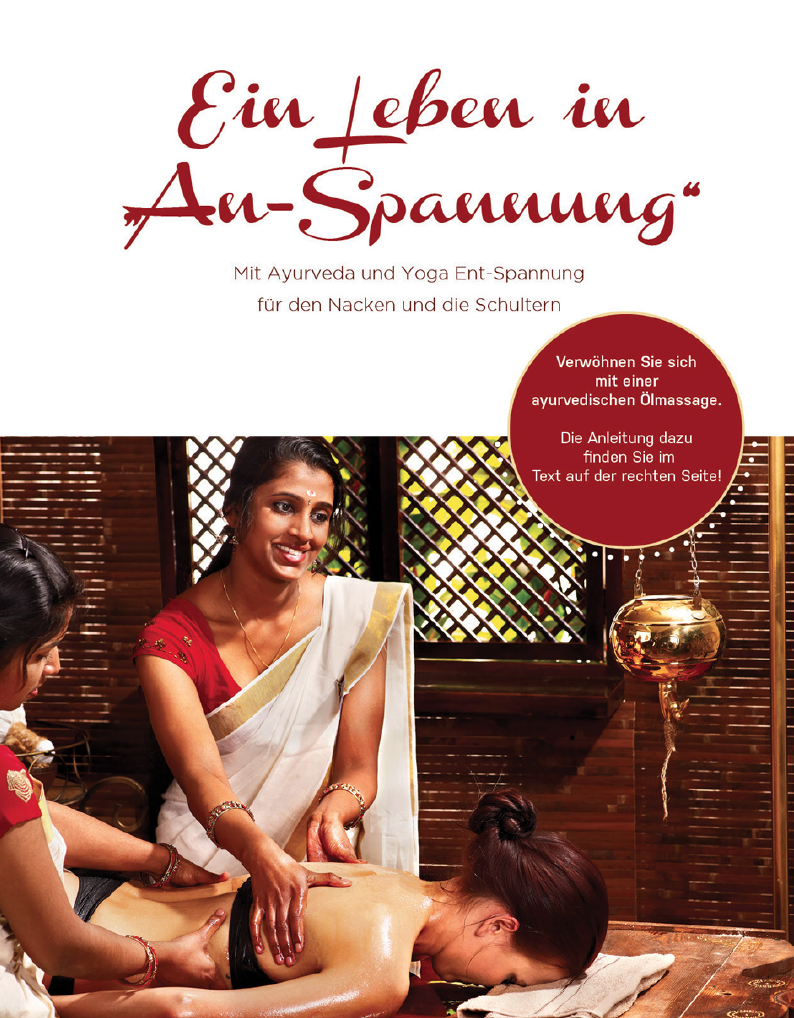
Pamper yourself with an Ayurvedic oil massage
Here are the instructions: Warm 50 ml of oil (sesame oil or St. John's wort oil mixed in equal parts with arnica oil) in a water bath and find a warm, quiet spot. Pour the warm oil into a small bowl. Make yourself comfortable and lay a few large towels on the floor. Start by lying on your back with your legs up. Spread the oil on your stomach in clockwise circles, slowly and with pleasure, then on your upper body and arms, with long, gentle strokes up to your fingertips. if you are alone, oiling your back is a good exercise for the muscles. It is easier to reach the back when lying on your side. The legs and bottom are also easier to reach. Be playful and imaginative, feel what is happening in your tissue and where. Get to know your body in a new way and enjoy it. Massage has to do with love, and self-massage has to do with loving yourself. Give yourself attention and love. Feel it, get a feeling for your body again. Let the oil soak in for 15 minutes and then take a hot bath or shower.
4 relaxation exercises for neck and shoulders
1. Sit up straight on the chair/stool, preferably on the edge, and press your tailbone into the chair (this activates the pelvic floor and tilts the pelvis). Let your arms hang loosely at your side; now consciously pull your shoulders up to your ears with each inhalation. Hold them up briefly and hold your breath, then consciously exhale - you can also do this with your mouth open - and push your shoulders back down. Do this exercise twelve times.
2. Now circle your shoulders by placing your hands on your shoulders, with your fingertips pointing forward over your collarbone towards your feet and your thumb resting on the back of your trapezius muscle. Circle five times in both directions (forwards and backwards) and also in the opposite direction (as when rowing).
3. Stretch your arms out to the side and apply tension to your fingertips. Focus your attention on your shoulder blades, bring them together and stretch your arms slightly backwards. Do this exercise twelve times.
4. Now bend your arms and bring them forward as if you had to defend yourself against something. Now bring your right arm into your left arm and place both elbows on top of each other, crossing your forearms and placing your palms together. This looks very twisted, but will have an unexpected effect if you now bring your elbows to shoulder height. Now pull up a little at a time and hold this position for about a minute. Then switch to the other side.